
What high boiler pressure means, the usual causes, the safe checks you can make and when to call a Gas Safe engineer.
Blog
Why is my boiler pressure too high, and is it safe?
Whittaker Plumbing & Heating
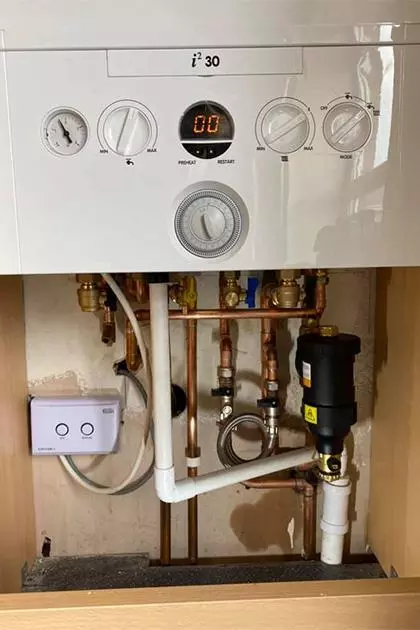
If the needle on your boiler's pressure gauge is creeping into the red, don't panic. Boilers have a safety valve that lets water out before the pressure gets dangerous, so high pressure isn't usually an emergency. But it is a sign something isn't right, and if it keeps happening it can damage the valve and lead to leaks and breakdowns.
This post explains what normal pressure looks like, the most common reasons it climbs too high, what you can safely check yourself, and when to book an engineer. Never take the boiler's casing off or adjust any valves inside it. That's a job for a Gas Safe registered engineer.
What's normal boiler pressure?
Most combi and system boilers have a pressure gauge on the front or underneath. As a rough guide:
When the heating is off and cold, the pressure should usually sit between 1 and 1.5 bar.
When the heating is on, it rises a little as the water warms and expands, often to around 2 bar.
Above about 2.5 bar, it's on the high side, and many gauges show this in red.
At 3 bar, the pressure relief valve is designed to open and let water out.
Your boiler's manual will give the exact range for your model. A slight rise when the heating comes on is normal. A pressure that keeps climbing, or sits high even when the boiler is cold, needs looking into.
The most common causes
The filling loop was left open, or the system was overfilled. The filling loop is the short hose or tap under the boiler used to top up the pressure. If it wasn't closed fully after the last top-up, or too much water went in, the pressure stays high. This is the most common cause and the easiest to fix.
The filling loop is letting water through. Even when it's switched off, a worn filling loop valve can let a slow trickle of mains water into the system, so the pressure creeps up over days.
The expansion vessel has lost its air. The expansion vessel is a small tank inside or near the boiler that gives the water room to expand as it heats up. Over time it can lose its air charge. When that happens, there's nowhere for the expanding water to go, so the pressure shoots up when the heating comes on and falls again when it goes off.
A fault inside the boiler. On some combi boilers, a worn part inside can let mains water into the heating side, pushing the pressure up. A faulty pressure gauge can also give a false high reading.
Signs to look out for
The gauge is in the red, or near 3 bar
Water dripping from a small copper pipe outside, near the boiler. This is the discharge pipe from the pressure relief valve.
The pressure rises sharply every time the heating comes on
The boiler shows a fault code or locks out
If water is dripping from the discharge pipe, the relief valve is doing its job, but it means the pressure is reaching 3 bar. Valves that open often can start to leak, so it's worth getting it checked.
What you can safely check yourself
Make sure the filling loop is closed. Check both taps or levers on the filling loop are fully off. If you've just topped up, this is often all it takes.
Let the boiler cool and check again. Turn the heating off for an hour or two, then look at the gauge. If it drops back into the normal range when cold, the expansion vessel may be the problem.
Bleed a radiator to bring the pressure down. Letting some water out through a radiator's bleed valve lowers the pressure. With the heating off and the radiators cool, open the valve slowly with a radiator key, hold a cloth underneath, and close it again once the gauge drops to around 1 to 1.5 bar. Our guide on how to bleed a radiator shows you how.
Watch it over the next few days. If the pressure stays where you set it, the problem was probably an overfill. If it climbs again, there's a fault to find.
Don't touch the pressure relief valve, try to recharge the expansion vessel yourself, or keep releasing water day after day to hide a rising pressure. Each time you add fresh water, you add fresh oxygen, which leads to rust and sludge inside the system.
When to call an engineer
Book a Gas Safe registered engineer if:
the pressure keeps rising after you've closed the filling loop
it shoots up every time the heating comes on
water keeps dripping from the discharge pipe outside
the boiler shows a fault code or keeps locking out
An engineer can test and recharge the expansion vessel, replace a worn filling loop or relief valve, and check for faults inside the boiler. Our boiler repairs page explains how we find and fix faults. If your boiler shows a code, our guide to boiler fault codes explains what to note down before you call.
High pressure, low pressure
Pressure problems work both ways. If your gauge keeps falling instead, the cause is usually a leak or a worn valve, and our guide to combi boiler pressure that keeps dropping covers that side. Either way, a yearly boiler service is a good time to have the pressure, the expansion vessel and the relief valve checked before winter puts them to the test.
Other Articles


